Showing posts with label electric fence charger. Show all posts

Tuesday, May 15, 2018

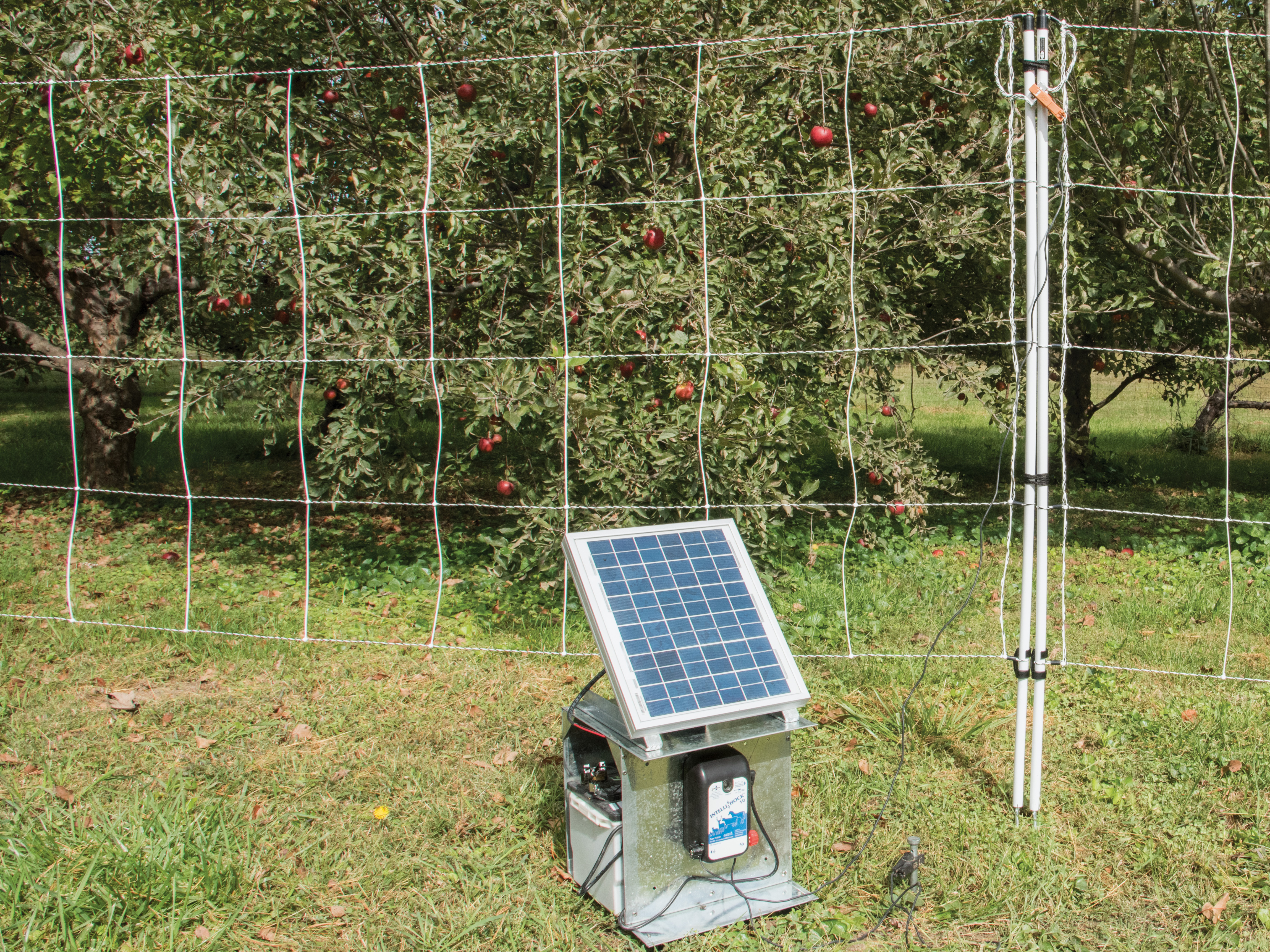
How to pair a battery energizer and solar panel


When choosing a solar panel for your battery energizer; energizer draw (amps), available sunlight per day, and battery size all affect the output wattage needed.  


Determining the solar panel wattage needed to supply an energizer with power is relatively simple. To do so we use the Power Formula, P = EI. P is the wattage required, E is the battery's voltage, and I is the energizer's amperage draw.

Example, an energizer with a 100mA (.1 amp) per hour draw and a 12v battery would require 1.2 watts per hour, 28.8 watts or 2.4A throughout the day. The solar panel needs to supply the 2.4A to the battery in order for it to remain charged.

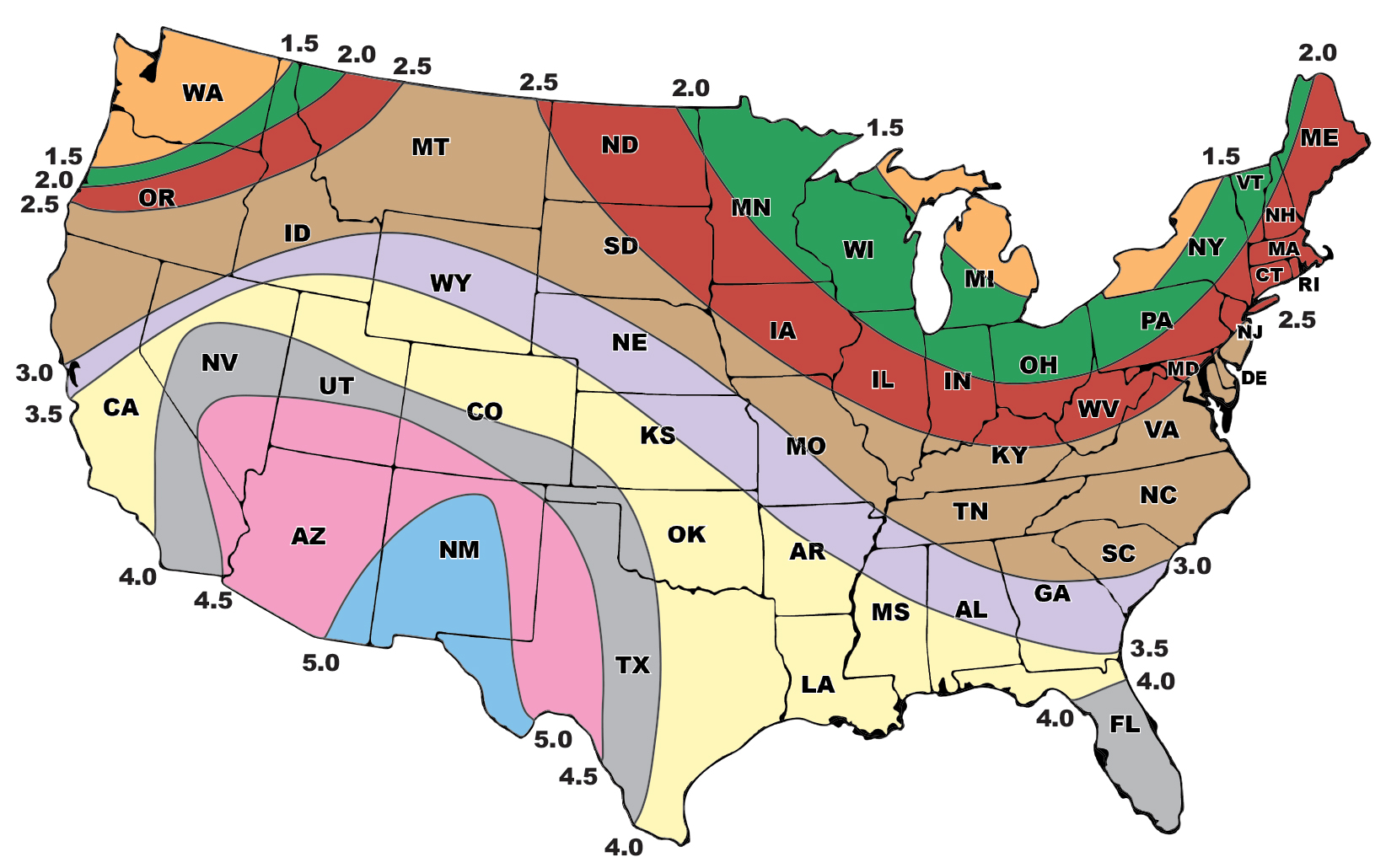
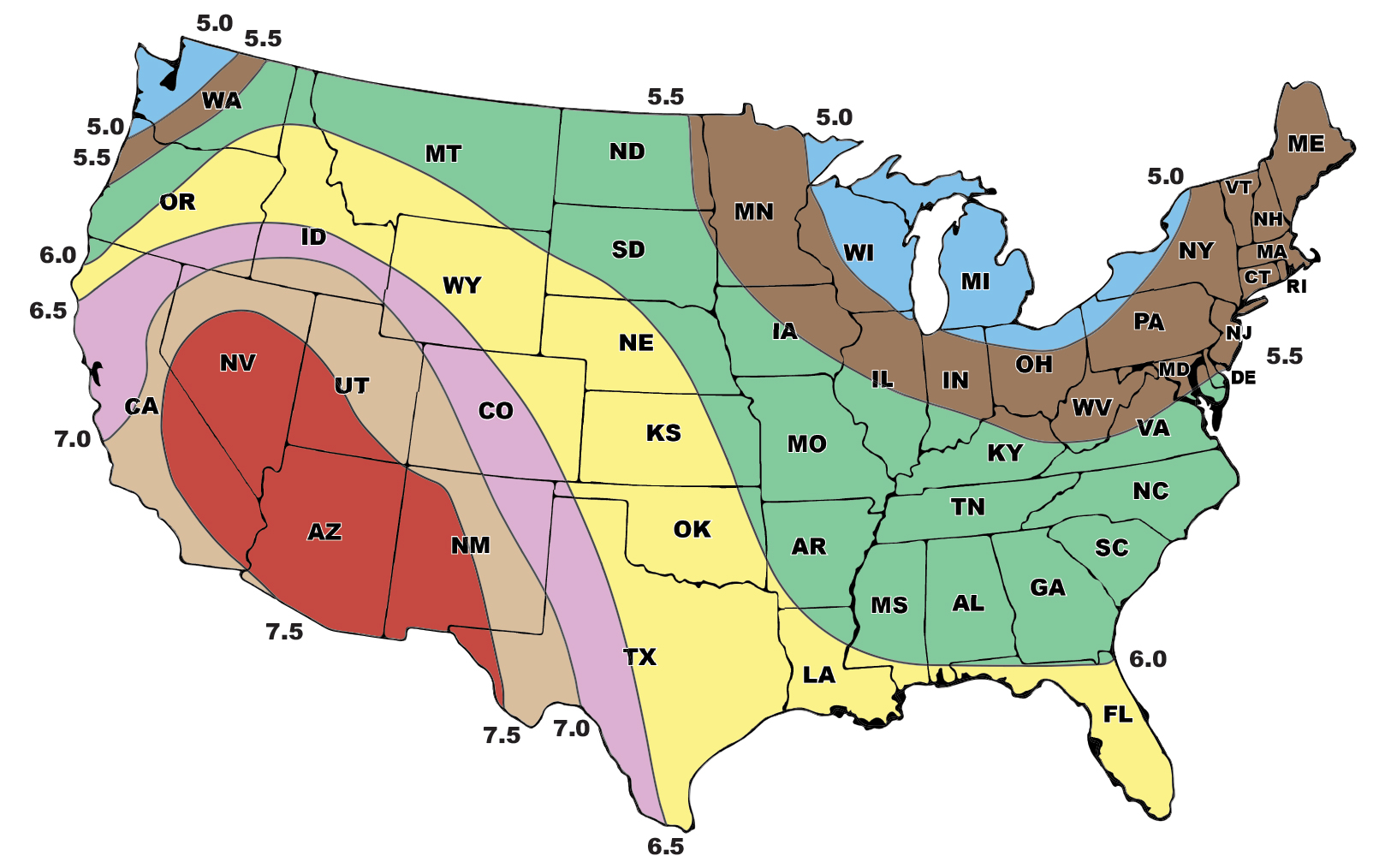
Now the fun part. It's not sunny 24 hrs a day. During the summer months, Premier receives about 5.5 hours of usable sunlight at our farm in SE Iowa (the panels are not tracking the sun). (Charts below indicate average hours of sunlight based on location and time of year.) This means the battery will be the sole power source for 18.5 hours "overnight". That's 1.85A. The panel will have to produce a days worth of energy in only 5.5 hours. That would be 2.4A/5.5 hours = 0.44A per hour. Recall that P=EI, so P = 12V x 0.44A = 5.3 Watts. A 5.3 W panel would provide enough current to run the energizer during the 5.5 hours or sunlight, plus enough current to replace what was used overnight.

Summer sunlight, hours available per average day. 

Winter sunlight, hours available per average day.

What about cloudy days where the panel is not supplying current? Assume Day one was sunny and the battery was topped off at sundown. Day two is cloudy. Sundown to sundown is 24 hrs, plus another 18.5 hours until Day 3 when the sun rises. That's 42.5 hours or 4.25A that needs to be recharged within 5.5 hours. Don't forget we also need to power the energizer until sundown on Day 3, so add .55A to that total, 4.8A. What's the wattage required? 4.8A / 5.5 Hours = 0.87A per hour. P = EI, 12V x .87A = 10.44 W.

The battery size determines the the number of days the energizer will run without sun light. The solar panel determines how many days it will take the battery to recover to full charge after a cloudy day(s).

For those wondering, what size energizer uses 100mA per hour? Most units in the 1 joule output range consume that much power.
If an out-of-box solar energizer kit does not fit your needs, a set-up to fit your situation can be easily designed using the formula above. Happy fencing!

Friday, January 29, 2016

A major fence energizer mis-truth

Those who have researched energizers have more than likely (almost certainly to be exact) encountered the Miles or Acres claims on energizers.

That's too bad, as this often causes folks to purchase an energizer that is too small for their fencing needs. How so? The number of miles or acres advertised roughly energizes a single strand conductor, above the ground (no grass contact) with moist soils for that distance—essentially lab conditions.

In comparison—an in use energizer's field conditions involve moist or dry soils, one or many conductors of varying conductivity and grass contact—much more resistance to and drainage of the energizer's pulse.

Points to consider regarding overall fence resistance and pulse strength:
  • Poor conductors (high ohms = high resistance) inefficiently carry an energizer's pulse throughout the fence line. 
  • Multiple conductors increase a fence's overall resistance. 
  • Grass contact (weed-load) drains energy from a fence. 
  • Dry soils lack the conductivity to adequately carry an energizer's pulse back to the negative terminal of the energizer. 
An accurate way to gauge an energizer's performance is its joules of output rating. A joule is the volume of electrical energy in a pulse. The higher the joules, the more energy available (after loss to weed and poor conductivity) to be sent down the fence—the larger the pulse, the higher its strength at the end of the fence.

But how many joules are needed for a specific fence?

The answer is it depends. A rule of thumb some go by is .25 joules per roll of net. Gordon (a Premier Consultant) goes by .5 joules per 3-5 nets (ElectroNet) if you maintain weed-load. That means if you keep the grass short enough (not totally eliminated) you should be able to get 3-5 rolls of 164' net energized (depending on soil conditions).

For more tips on choosing a fence energizer, read this blog-post. It goes over how to use our Energizer Comparison charts.

The miles rating is certainly an effective way to sell energizers but it doesn't say what the voltage will be at the end of that wire—there may be some, but possibly not enough to deter animals.

Friday, January 22, 2016

Electric fence basics: Conductivity


An energizer sends a pulse (measured in joules) through the fence. When an animal touches the fence the pulse travels through them, to the soil and to the ground rod. The pulse travels from the ground rod to the energizer completing the circuit.

Conductivity is the measure of how easily an energizer's pulse flows through the electric fence. Better conductivity results in a more consistent pulse (no loss of strength) from the energizer to the end of the fence. 

The lower the conductivity, the higher the ohms. More ohms = higher resistance to the flow of the energizer's pulse.

Low conductivity means more resistance to the pulse (measured in ohms).
  • Low ohms = low resistance
  • High ohms = high resistance
How does this information apply to an electric fence?
The pulse is made up of a group of electrons that travels through the fence circuit. Over distance (throughout the circuit), the pulse loses electrons—similar to erosion—from the resistance. More resistance = more electron loss. The fewer available electrons at the point of contact/end of fence, the weaker the felt pulse.

The better the conductivity, the fewer electrons lost, better possibility for a deterring shock.

Dry/rocky/sandy soils tend to lack moisture, which results in poor conductivity. The best way to try and overcome this is to use wide-impedance energizers, increase the total feet energizer grounding (ground rods) or use pos/neg fence.

Build fences with low ohm conductors. This includes the majority of our white or green netting, black and white conductors and MaxiShock. This will aid in lowering the overall resistance of the fence.


Thursday, November 26, 2015

Electric Fence Pulse

A pulse from an electric fence energizer lasts less than 3/10,000 of a second. The pulse's strength can reach up to 10,000 volts. That sounds extreme but static electricity is often as much as 25,000 volts.

Thursday, July 10, 2014

What you need to know about ground rods

Make sure ground wires are firmly connected to the ground rod. 
Ground rods may seem to be just a trivial item. After all, they're just a metal rod you pound into the ground. They seem more of an anchor for the energizer than anything else. Don't be deceived by their unassuming demeanor, ground rods are vital.

How so? Try using an electric fence without the recommended amount of ground rod (3 ft per joule of output). For example, if using a PRS 100, an energizer with 1 joule of output, pull the ground rod out of the ground by a foot or two. Check the voltage of your fence (with a fence tester). Pound the rod back into the ground. Check the voltage again. See a difference?

We've established that it's important. Next, let's look into how an electric fence works. 
  1. The energizer fence terminal sends an electric pulse through the fence's conductor(s). 
  2. An animal touches the conductor. 
  3. The pulse travels from the fence through the animal and into the ground. 
  4. The pulse moves through the soil (via moisture) and to the ground rod. 
  5. The pulse goes up through the ground rod and back to the energizer (via the ground rod). Completing the circuit (and the animal receives a shock, learning to stay away from the fence). 
Note: all of above happens in 1/10,000 of a second. 

So what does the ground rod do? It picks up the pulse from the ground and brings it back to the energizer. 

However, if the energizer has a stronger pulse than the rod can pick up, an electrical charge can build up around the rod. Since the full power of the pulse cannot travel through the ground rod, an animal will not receive a full powered shock. The remedy? Pour water around the ground rod to increase the conductivity around the ground rod(s), or add additional rods. 

Why is this ground rod so far out of the ground? It's likely because we are using a 1 joule energizer and a 6' ft ground. At 3' of rod needed per joule output, the full 6' is unnecessary. 
It is possible to test to see if your ground rod is not adequate. Ground out the fence—with the fence off, place a metal rod on the ground and lean it against the fence's conductors. This will cause a 'dead-short' to the ground. Using a digital voltmeter, stick the ground probe into the ground and touch the fence probe to the rod. If a reading of more than 300v appears, you need more ground rod. Under 300v, you have adequate grounding.

Connecting an energizer to its grounding system.