 |
| A few of our expectant mothers enjoying an early morning snack. Ewes marked with blue are expecting singles, green-twins and orange-triplets (or more). |
Showing posts with label breeding season. Show all posts
Showing posts with label breeding season. Show all posts
Thursday, August 27, 2015
Photo of the Day


Tuesday, August 18, 2015
New for the 2015 breeding season!
 |
| Premier’s new Deluxe Marking Harness—notice the padded white strap at the underside of the arm. Strap does not “cut into” the front legs as other nylon harnesses are prone to do. |
A much better Ram Marking Harness
|
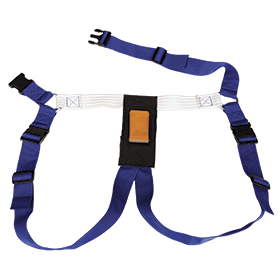
Why is our new Deluxe Marking Harness a world class harness?
| 1. | Wider (2"), soft nylon straps—distribute pressure more evenly over the ram’s body. Also easier to find and adjust the straps when they’re in deep wool. |
| 2. | Unique padded (1/5 in. thick) white straps behind the front legs to prevent skin abrasion. |
| 3. | Much larger snap buckles and metal loops—harness’s connection and stress points are reinforced. Even gloved hands can manipulate the large snap buckles. |
| 4. | Crayon holder is also padded. |
| 5. | Uses standard crayons. |
When we brought the rams in from breeding last autumn—little to no wear in the brisket area and behind the front legs. Bottom line? This is the best ram marking harness we've ever used or sold. Click here for Deluxe Marking Harness instructions.
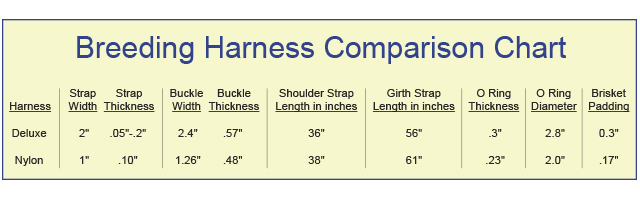
Nylon Breeding Harness
For mature rams of medium and large breeds with broad briskets. Durable nylon straps. Strong plastic snap buckles allow adjustment as needed and rapid fitting. More likely to stay on if the ram’s brisket has 3 months’ wool growth.
Marking Crayons
3 temperature ranges: Cold (25º - 65ºF), Mild (65º - 85ºF) and Hot (85º-100ºF). Mild and cold crayons wear very quickly when it's hot. Hot and mild crayons don't mark well when it's cold. We wish that one crayon would work for all conditions.... but such a crayon does not exist. And a warning—the marks from any and all breeding crayons may not be scourable.
Thursday, August 14, 2014
Marking Crayon Test
We've been thinking about breeding season since lambing season. In fact, during lambing season we were thinking about breeding season. We marked twin and triplet born ewe lambs (they're ear notched when we ear tag) and marked (with SI-RO-MARK or Sprayline) which ram lambs to keep intact.
We're planning to breed 475 ewes this season. Rams went in May 1st with a select group of hair cross ewes. The remaining ewes will be bred in groups with plans to have breeding finished by Mid October (we're shooting to have our last lambing day on March 15th. To keep track of who has been bred and who hasn't we're using marking harnesses and raddle marker. Not exactly sure which as the farm guys haven't put the rams in with the ewes.
 | |
|
 |
Yellow and blue were the least readable a week after marking (by hand, not by a ram). Test was at Premier in SE Iowa in July. Purple, green, red and orange were the most readable colors.
|
 | ||
Purple and red were the most readable. Green, blue and orange less so. Yellow the least (but still readable).
|

Thursday, January 24, 2013
Lambing Season 2013
 |
| Carl dressed to the 9's (degrees that is) and finishing morning chores in the lambing barn. |
This year our experiment is using a former warehouse as a lambing barn. This new "barn" offers protection from the elements as well as the option of heat (a real treat). There are some kinks that need to be worked out: feeding, watering and ventilation.
For feeding, the farm guys have been busy building single-sided feeders (using our plans and panels of course). They're arranged to form an alleyway, which allows someone to walk down the center and drop feed to the ewes w/o the need to get into the pen (which is nice since many are carrying twins or triplets.
 |
| A bucket placed in a Premier single-sided feeder. The clip was replaced with a Premier bucket holder for added stability. |
There are some ventilation issues to work out—the building was not originally designed as a barn. Keeping livestock in the building will bring in considerable moisture. We'll have to be vigilant about clean bedding and getting clean air into the barn. We're planning on installing a vent pipe, it's just a matter of what size and where.
Tuesday, December 4, 2012
Cold Weather Shepherding tips
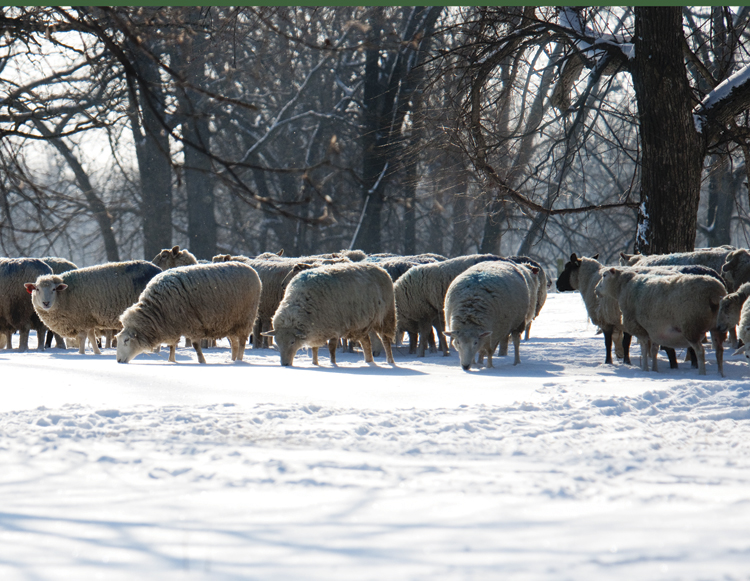
It’s December which means winter—in theory—will be here soon. Currently it is 66° in Washington, IA but that could change to 10° in an instant (after all, it is Iowa weather). Here are a few tips for dealing with the highly anticipated cold weather.
- Gordon Shelangoski (Premier product consultant and shepherd) utilizes molasses tubs as a supplement to his stockpiled forage. The added energy provides what the late season forage can't. Gordon can graze his ewes longer without having to provide stored feed. Purchasing a few tubs pencils out to being more cost efficient for Gordon than buying in hay. If you choose to try molasses tubs, make sure they are formulated for sheep specifically. Non-sheep specific tubs have high copper levels which leads to copper toxicity in sheep.
- Make sure the water supply is winter ready. Add tank heaters and know your protocol for frozen tanks and hydrants. Water is especially important during late gestation and lactation.
- If you buy-in feed, make sure it is either on your farm or at least spoken for. Searching for hay in mid-winter is not going to be the most cost effective means of procuring feed.
- Machinery needs to be in good repair and ready to run in the winter. If you run a diesel, make sure to have winter blended fuel or at least a bottle of anti-gel additive.
- Temporary fencing that will not be used during the winter needs to be picked up and stored. This reduces the chances of it being damaged by snow, ice and animals.
- Fences that will be in use throughout the winter need to be functional. Go through and remove overgrowth/fallen limbs that may reduce the strength of the pulse going through the netting. If you have a fence that can be modified into pos/neg, do so. This will allow the fence to function better with deep snow.
- If your winter plans involve lambing, make sure the lambing barn/area is cleaned and ready to handle sheep. Set up lambing jugs and pens ahead of time.
- Make sure your lambing kit is ready. You do not want to be out of teats for bucket teat units when you have orphan lambs. Being prepared ahead of time saves a trip to town when you need to be treating a ewe or lamb.
Thursday, September 13, 2012
Breeding Season 2012

(photo) Two Katahdin rams demonstrating a Cross Your Heart Harness (left ram) and a Nylon Harness (right ram). These rams were put in with the ewes on Sept. 1.

(photo) Moments before the rams are let out, Chloe the guard dog runs off to inform the ewes that the “boys are back in town.”
We are starting the breeding season in September instead of November because we have access to more indoor lambing space than in years past. We cleaned out a warehouse which had formally been a lambing barn. With the lambing barn returned back to its original purpose, we are now able to lamb more ewes indoors. This provides us with more space for lambing jugs, which we are more than happy to take advantage.

(photo) The rams eventually made up to the hill where the ewes were eagerly awaiting.
The breeding season doesn't exactly start as soon as the rams walk into the pasture with the ewes. During the summer, we brought in several rams to use this breeding season. They will add fresh genetics to our hair flock. We also need to make sure that our other rams are in top condition before heading out to the pasture. Once in a ewe filled pasture, rams tend to think about things other than eating and maintaining condition.

(photo) A few days after turning the rams out with the ewes. The orange marks are from the marking harnesses and crayons, an efficient way to determine which ewes have been bred and which have not.
We bring the flock in once a week to check and see which ewes have been bred. We are able to determine this by using marking harnesses with crayons or raddle marker. Marks allow us to better determine when a ewe is expected to lamb. We switch the crayons each time they are brought in. A switch in color tells us which ewes were bred later and which ones were remarked.
Other happenings at Premier…

(photo) The crayon marks stayed on the ewes even after a thunderstorm (background) rolled through.
The recent rains have rejuvenated our pastures. They have changed from dead brown hues to lush greens. On our North Farm we are strip grazing a grass/clover pasture. Every few days the shepherds set up a few additional rolls of ElectroNet and graze the ewes on a fresh strip of grass.

(photo) Strip grazing on the North Farm. Using ElectroNet to subdivide a large pasture so the flock makes efficient use of all the grass available.
We're also getting a few of our feeder lambs ready for sale. We'll be weighing them to determine which lambs are finished. We will also be taking notes as to which ear tags are in the lambs ears. When the lambs were born, we put in tags denoting their sire types (Hamp, Suffolk, Siremax or home raised). This will tell us which sires produced the heaviest lambs.

(photo) After one week, the sheep were brought in and the tags of bred ewes were read and documented. The crayons on the harnesses were switched from orange to green. Harness were readjusted as they tend to loosen during the first day or two of use.
It's catalog season! We've spent the last few months preparing our Equipment catalog. You should see it in your mailbox around the 3rd week of October. If you're not on our catalog request list, sign up here. It has many new items including drenchers, ear tags, scales, a sling for weighing ewes and even a new crook!

Hope the starting months of Fall are treating you and your flocks well.
-Premier
Subscribe to:
Posts (Atom)