Showing posts with label big bale feeders. Show all posts

Tuesday, December 4, 2012

Cold Weather Shepherding tips


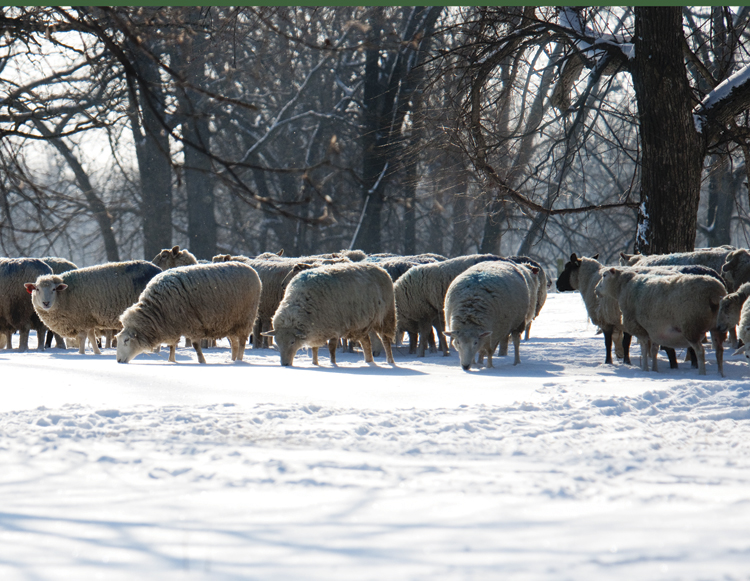
It’s December which means winter—in theory—will be here soon. Currently it is 66° in Washington, IA but that could change to 10° in an instant (after all, it is Iowa weather). Here are a few tips for dealing with the highly anticipated cold weather.

  • Gordon Shelangoski (Premier product consultant and shepherd) utilizes molasses tubs as a supplement to his stockpiled forage. The added energy provides what the late season forage can't. Gordon can graze his ewes longer without having to provide stored feed. Purchasing a few tubs pencils out to being more cost efficient for Gordon than buying in hay. If you choose to try molasses tubs, make sure they are formulated for sheep specifically. Non-sheep specific tubs have high copper levels which leads to copper toxicity in sheep. 
  • Make sure the water supply is winter ready. Add tank heaters and know your protocol for frozen tanks and hydrants. Water is especially important during late gestation and lactation.
  • If you buy-in feed, make sure it is either on your farm or at least spoken for. Searching for hay in mid-winter is not going to be the most cost effective means of procuring feed.
  • Machinery needs to be in good repair and ready to run in the winter. If you run a diesel, make sure to have winter blended fuel or at least a bottle of anti-gel additive. 
  • Temporary fencing that will not be used during the winter needs to be picked up and stored. This reduces the chances of it being damaged by snow, ice and animals.
  • Fences that will be in use throughout the winter need to be functional. Go through and remove overgrowth/fallen limbs that may reduce the strength of the pulse going through the netting. If you have a fence that can be modified into pos/neg, do so. This will allow the fence to function better with deep snow.
  • If your winter plans involve lambing, make sure the lambing barn/area is cleaned and ready to handle sheep. Set up lambing jugs and pens ahead of time. 
  • Make sure your lambing kit is ready. You do not want to be out of teats for bucket teat units when you have orphan lambs. Being prepared ahead of time saves a trip to town when you need to be treating a ewe or lamb. 


Tuesday, July 31, 2012

Best laid plans


The hot and dry weather has hammered our pastures as well as our flock for the last several weeks. In this weather the ewes are not overly motivated to graze, which is good considering the pastures have all but burned up. What are some of the things we are doing and not doing to ease the stress on our flock and pastures.

To alleviate the stress on our already brutalized pastures, we have started to feed baleage leftover from last year. The lush springs of 2010 and 2011 (which are but just a memory) provided us extra feed from the proceeding year. Since, 2010 we have had extra baleage, though it seems we will have just enough to get us to the hopefully green pastures of 2013. The Big Bale Feeders were pulled out of storage sooner than expected and our late born pasture lambs will be weaned sooner than anticipated, but as the saying goes "the best laid plans of mice and men often go awry."

photo: Ewes and lambs eating grass hay from a Big Bale Feeder. 

For those who maintain CRP land (Conservation Reserve Program), they are now able to hay or graze these pieces of land. Premier has a few employees who have CRP ground, we suspect they will take advantage of the grazing (check with your local FSA for rules and requirements). Premier has some ground that we keep as prairie. The sheep are on it in the Spring for lambing and are off it for the rest of the year. This year we will graze it in order to extend our grazing season before breaking into stored feed.


photo: Ewes grazing a late planted soybean field. Soybeans can tolerate heat better than some of the other grasses on our farm. 

When it comes to working the flock in the high heat, we do it only when necessary. For example, last week we had several ewes demonstrating classic worm burden symptoms; lethargic, loose stool and bottle jaw, thus they needed to be wormed. Worming in 100° weather is not comfortable for the sheep or the shepherd. So our shepherds drove and wormed the flock in the early hours of the morning while it was still cool. This cuts down on the amount of stress our ewes experience. 


photo: Building fence during a drought is not an easy task. The spikes often refuse to go into the hard dry ground. It is often necessary to use a drill to make a pilot hole for the spike (below). If you're lucky, there might be a crack in the ground where you want to put the post.