We have a few positions open—
Product Consultant
Assist customers by providing needed advice on farm and backyard related products. Essential skills: farm/livestock experience, curious mind, pleasant style/tone on the phone, interpersonal and computer skills.
Purchasing Manager
Organize the acquisition and distribution of product from all over the world via road, sea and airfreight. Essential skills: good interpersonal, computer and spreadsheet skills. Prior experience strongly preferred.
Facility Maintenance
Job includes building/HVAC/electrical upkeep and internal
office construction.
All above include full-time with benefits. No smoking.
Telephone Receptionist
Job includes clerical skills. Needs excellent people skills, high attention to detail, basic computer skills. Part-time or full-time with benefits. No smoking.
For all positions please contact jpotratz@premier1supplies.com
Thursday, January 9, 2014
Friday, December 13, 2013
Heat lamp hints
Here's a hint for the occasions that you need to change a bulb in a Premier Heat Lamp: use pliers.
For some, it's difficult to squeeze the clips together in order to open the lamp's grill.


Simply squeeze with a pair of pliers to open.


Thursday, December 5, 2013
Recharging 12v batteries…
We're going to discuss a 40% charge. Don't worry, it has nothing to do with our pricing, so you can breathe easy. However, it does have to do with some of our batteries.
When we sell a battery, we recommend it not going below a 40% charge. All right, that's easy to figure out. A 12v (volt) battery holds 12v, 40% of 12 is 4.8 or 4.8v. That line of thought is incorrect.
12v batteries are fully charged at 12.6v and are depleted or 0% at 11.7 volts. Some energizers will function even when a battery is below 11.7v. However, this will cause damage to the battery. So a 40% charge is slightly over 12.1v. Clear as mud right? For 12v batteries we use the chart below for determining charge percentages.

When we sell a battery, we recommend it not going below a 40% charge. All right, that's easy to figure out. A 12v (volt) battery holds 12v, 40% of 12 is 4.8 or 4.8v. That line of thought is incorrect.
12v batteries are fully charged at 12.6v and are depleted or 0% at 11.7 volts. Some energizers will function even when a battery is below 11.7v. However, this will cause damage to the battery. So a 40% charge is slightly over 12.1v. Clear as mud right? For 12v batteries we use the chart below for determining charge percentages.
How do you determine the voltage of your battery? Use a Battery Charge Meter to check the voltage. Use a ReCharger for 12v batteries to charge batteries. If you have a 12v voltmeter (not a fence tester), test your battery after charging. Try to avoid going over 13-14v charge on a 12v battery. Overcharging is similar to blowing up a balloon until it pops. You may continue getting air into it, but eventually it's going to pop. Our battery won't "pop" but overcharging does cause damage and will reduce its usable life. -
Monday, September 23, 2013
Tips for setting up netting successfully
On occasion someone will call in or email and ask "my net is sagging, what can I do?" There are a few options for setting up netting and reducing sag, we'll go over them below.

The first three options cover what you can do with net you already have. If you're planning on purchasing net, look into using a Plus net for areas with corners and curves.
- Added posts: For folks who already have the net in their possession and need a little "lift" added posts are their best option. They can be placed anywhere in the net for support. The downside is removing them before moving the net. It is possible to fold and roll the posts in with the net, depending on the post. Posts with multiple clips attached quickly make a nuisance of themselves by becoming snagged on other sections of the net.
- Resetting the net: When I set net, I only use posts for added support at corners, if needed. I can usually sneak by with no posts. How? Practice. Also working at Premier has honed my net setting skills. A major help at corners or for straightening sagging net is post placement. Instead of sticking the post into the ground straight up/down at a corner, stick it in at an angle so the top of the post leans away from the corner. The added tension will remove even the most stubborn of sags.
- Spike placement: When setting the net, move the spike with your foot for added tension, then stick it into the ground.
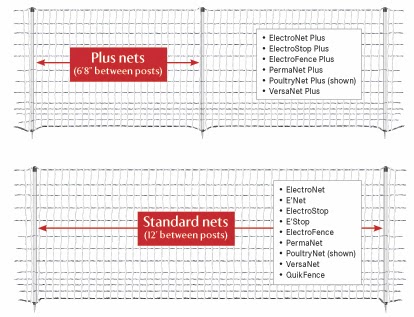
- Plus Nets: Nets with the term Plus after the name (ex. PoultryNet Plus) have additional posts built into the netting. The closer spacings reduce the amount of sagging between posts (which in turn aids in reducing ground to wire contact). The added posts increase the overall weight and bulkiness of the net, so we shortened the total length (not height). PoultryNet 12/42/3 weighs 1.5 lbs per 10' of net, whereas PoultryNet 12/42/3 Plus weighs 2.1 lbs per 10' of net. Plus nets are shorter in order to be lighter and less bulky, so they're more manageable for the user. An added benefit to Plus nets is their ability to handle corners and curves better than regular nets.
 |
| Post spacing comparison. The net in the back is PoultryNet Plus net with added built-in posts. Net in the foreground is regular PoultryNet. |
The first three options cover what you can do with net you already have. If you're planning on purchasing net, look into using a Plus net for areas with corners and curves.
Open position at Premier
Premier is looking for an Inventory Purchasing Assistant for acquiring product from all over the world via road, sea and airfreight. If qualified will advance to head of purchasing within 18 months. Requires good interpersonal, computer and spreadsheet skills. Contact dsutton@premier1supplies.com
Friday, September 20, 2013
Job Opening
Wanted: Product consultant to answer customer questions about farm and backyard related products for a mail-order business.
Essential skills: curious mind, pleasant style/tone on the phone, interpersonal & computer skills.
Full-time with benefits. No smoking.
2031 300th St, Washington, IA
Apply to bmcartor@premier1supplies.com
Friday, September 6, 2013
Energizer Impedance
Southeast Iowa has been dry for the last few weeks. Last year we went over drought fencing tips. This year we thought we would go over energizer impedance.
Impedance is similar to resistance. For energizers it means the level of ohms (resistance) that matches an energizer’s peak output. If low ohms then it's a low-impedance energizer.
The first fence energizers (50+ years ago) were high-impedance units. Their maximum output occurred when the fence was weed-free. They could cope with drier soils but were very vulnerable to weed contact. Most were too small in output to be effective against difficult animals. The next generation was low-impedance energizers. They coped well with high weed contact but not with dry soils or poor conductors. They work best against low-resistance animals (cattle, horses, pigs) standing on moist soils.
“Wide-impedance” is Premier’s term for newer units that perform well in both dry and wet soils and in green and brown grass. In dry soils or with animals of high resistance (goats, wildlife and poultry), wide-impedance units out perform low-impedance units of similar output.
The graph below compares 2 low-impedance units with a wide-impedance energizer (the 506).
- Note when each excelled.
- Note also that the larger low-impedance unit did better than its low-impedance little brother in all conditions.

- An energizer’s output is not a constant. The stated number on the outside of the box is a peak. It’s never more than stated and almost always much less.
- The shape of the curve is important. The chart illustrates 2 output curves, in joules. One is that of a wide-impedance energizer with 2.7 joule peak output. The other a low-impedance charger with twice (5.2 joules) the peak output.
- The low-impedance unit excels when the soil is moist, the grass is green, the animal is a good conductor and there are plenty of ground rods.
- Wide-impedance units excel at stopping animals when the total resistance is higher, the grass is brown, the soil is drier (but not arid), the animal is not a good conductor and the ground rod(s) are less in total length.
- The higher an energizer’s peak joule output is at 500Ω, the more likely it will be effective when there is high green-weed contact on the wires close to the ground.
- The higher an energizer’s output in joules at 5000Ω, the more likely it is to be effective when the soil becomes dry.

Wide-impedance energizers are able to deliver high-pulse energy levels and high voltages through a wider range of fence situations—including those with high total fence circuit resistance due to inferior polywire/netting; dry, sandy, rocky soils; dry, brown grass; and fewer ground rods. Animals have greater respect for and fear of fences energized by wide-impedance units.
Joules of pulse energy at the end of the fence (and thus the potential pain available to animals) drop as the total resistance of the fence circuit increases—due to wet soils becoming dry, reliance upon stainless steel polywire and tape fences, or fencing across sandy/rocky soils. Low-impedance energizers deliver high pain potentials when the resistance is low (hence their well-deserved reputation for working well when the soil is moist and the grass is green), but much less as the combined resistance of the soil, animal and wire rises.
Subscribe to:
Posts (Atom)