Thursday, May 23, 2013

Sheep cheese comes to port

You might want to sit down for this. We're thinking about selling cheese. Not just any cheese that you can find in a store. This will be special cheese. The kind whose flavor sticks to your palate and is complimented (if not enhanced) by a good glass of port. The cheese we're thinking of providing is sheep cheese. Nothing is set in stone, we're just baaing around the idea for now. No promises. In truth, a few of us suspect the idea was just an excuse to eat some sheep cheese.

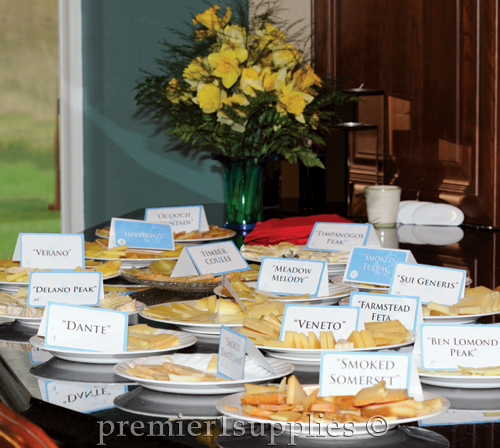
The spread. 
As the copywriter, I have the solemn responsibility of writing about our products, so I took the task of taste tester upon my shoulders for the good of the company (and ultimately our readers in case we decide to sell the cheese). I wouldn't want to force someone else to stuff themselves with cheese after cheese after cheese.

And so late last month, I found myself sitting in the dining room of Stan and Jean's house. Laid before me was an array of 24 sheep cheeses. An abundance of colors, shapes and textures were evident. There were several creamy whites, translucent yellows and a smattering of blues and greens.

Accompanying the cheese was a selection of grapes, olives, sliced apples and bread. Their purpose was to cleanse the palate between each sample of potentially potent cheese.

Each cheese was rated on the scale of "Would you want to eat more of this?" The cheese could be ranked as "Yes! (I would eat more)", "I'm not sure…" and "Not in a million years." Of 24 cheeses, I had 5 I'm not sure's and 19 Yes! For me, not one cheese ranked as not in a million years, then again, I'm a huge fan of lamb face salad and my taste buds can handle most flavors. Others were not so amiable to enjoying certain cheeses in the future.

The overall top pick for the group was Nancy's Hudson Valley Camembert, made from both sheep and cow milk. A very soft and easy to spread cheese. It tasted of creamy goodness. Enjoyed by all.

One of the many types of cheese we sampled. A "cousin" to Nancy's Hudson Valley  Camembert. Soft, creamy and delicious. 

I'll discuss my overall top pick for the tasting, Bohemian Blue. For me, all other cheese paled in comparison to the flavor of this cheese.

What type of cheese is Bohemian Blue? It's a blue cheese developed as a substitute to French made Roqueforts. Imported Roquefort's were subject to heavy tariffs for a few years so a U.S. made version was the obvious answer. The Bohemian Blue is dry and crumbly whereas the Roqueforts are drippy and wet. A few folks from Premier (Stan, Jean and Cheyenne) were able to enjoy some fresh Roquefort during the French Sheep Tour in 2011. Cheyenne conceded that Bohemian Blue was the next best alternative to the Roquefort she sampled overseas.

My take on the cheese—the second the cheese touched my tongue, my mouth came alive with energy. The previous 22 samples had dulled my senses, but they certainly woke up when I tried the Blue. The saltiness of the cheese was overcome by the sharp flavor that emanated throughout my mouth. I can't put into words the flavor of the cheese, I can only describe it as a really good blue cheese. I'm not typically a blue cheese fan but Bohemian Blue made me rethink how I look at cheese.

The tasting sheet. Each cheese was rated for taste and testers were encouraged to fill the white space with comments. 
What did others think of Bohemian Blue. Common comments were salty, sharp and great aftertaste. Not one person checked "not in a million years" for the Blue.

Will we be offering cheese in the upcoming years? That has yet to be decided, we might have to hold another tasting…or two.


Friday, April 26, 2013

Midwest Horse Fair 2013


Have you ever attended the Midwest Horse Fair in Madison, WI? Well one of our product consultants, Kolby, has gone the past few years and always comes back with good stories and good ideas.

There were about 53,500 folks in attendance and it seems almost every one passed through the booth. Kolby was lucky enough to have an indoor booth as it was slightly chilly and damp outdoors.


Since spring is more or less here, there was a lot of interest in Horse QuikFence and Trailer Paddock Kits. These easy to set up fences are handy for letting horses have some roaming room when they're at the show or on the trail.

Kolby mentioned folks who raised more than horses. Maybe next we'll show up with a little more than our horse fences. If you find yourself at the Midwest Horse Fair next spring, look for us and find out.


Thursday, March 28, 2013

Nitty-Gritty of Creep Feeding


Creep feeding provides additional feed and nutrition to lambs. This is typically done for market lambs to boost their weaning weight. Creep introduces lambs (before weaning) to the type of feed they will consume in a drylot (if they are to be drylotted).

A typical creep feeding setup consists of a small pen with a Premier Creep Gate on one side. The gate allows the lambs to enter the feeding area while keeping the ewes out. Since we have many lambs, our creep feeding area is large. We're using several of our 6'-8' panels connected to Premier's Build Your Own feeders and a creep gate.


An indoor creep area should be clean, dry and well lit. The light will attract the lambs and the clean/dry area will encourage them to stay there. If in a barn that is not well lit, hang a heat lamp above the creep pen. The bulb does not have to be a heat bulb, just something to provide a light source.

Outdoor creep areas should offer some protection from the elements while keeping the creep clean and dry. Since it is an area that many lambs will congregate, it should either be easy to move or easy to clean. 


The creep area should be in a location that is accessed by the ewe flock daily. The pen should be located close to the flock’s water source or feed source. It is not recommended to keep a water source in the pen as this can create wet/sloppy areas in the pen.

Since lambs are quickly growing, the creep should have a high protein content to build lean muscle. Consult a sheep nutritionist to develop the best system for your flock. 

A well designed and operated creep will help get lambs on feed soon and to market at an earlier age.

For more information on creep feeding visit:
Premier's Sheep Guide 
Maryland's Sheep and Goat website


Friday, March 22, 2013

Shearing 2013


It's that time of year again. Our later bred east farm ewes received their annual haircut shear yesterday. A few shearers kindly came up form Missouri to help us out.


Mike preparing to grab the fleece from shearer Ivan (he's the star of our shearing video). Don and Joe stood in the stalls and handed a fresh ewe to the shearers as soon as they finished the ewe they were currently shearing. 


The fleeces were inserted into a hydraulic power baler. Adrian (one of Premier's shepherds) ran the baler and helped pickup fleeces. He also caught the occasional loose sheep.


These scoundrels (Joe and Don) were busy handing fully wooled sheep to the shearers. This photo was shot while the shearers were changing out their combs/cutters. 

Thursday, February 28, 2013

Immediate Openings

Immediate Openings

Sales Phone Person
Position Summary: Talk to customers about our products and be able to patiently respond to their concerns.
Requirements: Phone and people skills. Able to learn and explain use/misuse of animal clippers, ear tags, electric fence, etc. Prior animal experience preferable—particularly sheep, goats, horses and outdoor poultry.

Purchasing Assistant
Position Summary: We buy product from all over the world. Our purchasing manager is retiring in 2 years. Will assist him to organize orders and delivery.
Requirements: Proficiency in Excel, Word. Operate forklifts.
Work Experience: Prior experience in purchasing.

Premier offers health/dental/life ins. benefits, 401K—plus annual merit bonuses. 

To apply: send resume by email to bmcartor@premier1supplies.com.

Wednesday, February 27, 2013

Goings on, happenings, catalogs and a lamb named Houdini.

Stan will be providing a lambing update in our Feb/March Newsletter. Make sure to sign up if you're not currently receiving our newsletters.

I myself have not been outside much this winter/lambing season. The weather (though mild) has been too cold and the coffee perfectly warm and comforting. In truth, the reason for my lack of polar expeditions was catalog season—non-stop since last fall. The result of my tireless efforts (with assistance from Stan, Jody, Kerrie, Rachel and others) are the Poultry, Equipment and upcoming Fence catalogs.

For those of you eagerly awaiting the arrival of the fence catalog, you may start camping by your mailbox around the 3rd week of March. Until then, the website, blog, Guide to All Things Sheep and newsletter should suffice as your source of info from Premier.

Though I've been inside, I have heard a few tails tales from the lambing barn.

The most notable occurred one morning when one of our shepherds (who shall remain nameless) burst into Graphics and thrilled us with the account of The Phantom Lamb.

While doing chores in the pre-lambing area (where the ewes are kept prior to being put into jugs for lambing) the shepherd heard a faint baa. A quick scan of the pen offered no insights to where the young voice had originated. More baas, but no lamb in sight. Frustrated and ready to move on with chores, our shepherd was moments away from dropping to his hands and knees to check under each ewe for the invisible lamb.

Another baa lead him to a baleage bale situated in one of our bale feeders. A ewe making motherly ewe sounds (you know, the deep throaty grumble that ewes make when speaking to their lambs) was inspecting the bale. Knowing that the ewe did not believe the bale to be her lamb, our hero checked the bale up/down and all around for a lamb trapped against a panel. No lamb.

Another lamb like bleat emanated from the bale. The ewe circled and searched the bale ring. Again, no lamb.

Our shepherd, stopped and pondered all the possibilities surrounding the situation. Could the lamb running around the bale in order to avoid the shepherd and the ewe? Is the lamb hiding elsewhere? Are gases from the silage process escaping the bale and making baaing sounds?

During this thought process, our hero noticed movement from one of the holes in the bale. The loose baleage moved! Had years of raising sheep using non-organic methods caused a mutation in the forage or did a lamb decide to play a drawn out game of hide and seek?

Quickly, the shepherd reached into the bale and below the loose baleage. After finding his target situating his hands in just the right position, he pulled and the lamb (head first with its legs under the chin) came out! Once our hero released the lamb, the lamb bounded straight to its mother for a belly full of milk. The shepherd, having just assisted a bale in giving birth, walked away to continue doing his morning chores and hoping for no more errant lambs.

Upon the ending of the tale, the Graphics folks were doubled over in laughter and I was preparing my next blog post. Names were removed to protect the dignity of the shepherd and all embellishments were added by myself, writers privilege.


Friday, February 22, 2013

How-to videos

We recently added a few how-to videos to our Facebook and YouTube pages. Most of the videos pertain to lambing season and could be helpful. Check them out if you have time this weekend.