Monday, June 27, 2011

Working the Fields


The last few weeks have been busy at Premier. The fields that have been grazed of their cool season forage have been transformed from stubble to sprouts. How did we get there?

We start by composting the bedding and wasted hay leftover by our winter flocks. The loose matter is pushed into a large compost pile where we allow nature to take its course. This involves the breakdown of organic matter and the production of heat. We want heat to occur to kill any weed seeds that may be lurking on our compost. We would rather not have those seeds present in our fields. In the photo above, Stan and Carl discuss the benefits of the dump scoop on our track loader. It certainly beats a pitchfork.

The breakdown of the bedding converts the larger pieces of "muck" into much smaller ones. This reduces the likelihood of the manure spreader's beaters becoming wrapped and stuck.

The heat produced in the pile also dissipates the moisture in it. This means that over time the pile gets smaller and less bulky. Less bulk=less loads to haul=less fuel used and less time spent. Does less bulk mean less fertilizer? Not necessarily, it just makes it more concentrated. The hydraulic bucket in the photo above is a pretty nifty attachment to have.

Once the spreader is loaded up we haul the compost to the fields to return the nutrients it gave us earlier when it was a hay field (the bedding and waste were originally harvested from these fields). Notice the fine size of the particles spread. Without composting these pieces would have been much larger. Large pieces tend to kill the growth under them and are harder to disk into the soil.

It's pretty easy to see where Carl has spread the compost. Hopefully Tharren used a highpower lens when he took these photos, otherwise it might have been a fairly fragrant photoshoot.

Kyle harrows the field to break up some of the larger chunks left by the disk. Disking allowed the compost to be worked into the soil rather than sitting on top of it.
Why is Mike dragging another harrow even after Kyle prepared the field with one? The second pass over the fields cover's the recently drilled seed.

Mike (in the tractor) after having finished planting soybeans and millet into the freshly fertilized and tilled ground. We planted the two because the forage that was originally there was a cool season forage. Cool season forages grow much better in the spring rather than the summer. Soybeans and millet are much better adapted to grow well in our hot and humid Iowa summers. We plan to start grazing sheep on this field when the beans and millet are 18 in. high.

Tuesday, May 10, 2011

On the Job Training


Photo: Stan with Thor, one of the many guard dogs protecting the flock at the East Farm.

Last week Tharren and I helped Stan do chores. The two main lessons I learned:
-->Why you move the guard dog throughout the pasture.
-->How to transport water without it splashing in the bed of your vehicle.

At the home farm we had to feed the feeder lambs, guard dogs, ewes with triplets (as they require extra "groceries") and orphan lambs. The lambs and ewes were located near one another, thus taking care of them was simple. The guard dogs are stationed throughout the farm. After crossing and recrossing several creeks and climbing several hills we finally took care of the guard dogs Sammy, Sadie, Grizzie and Grizzie's puppy.

The guard dogs have free rein throughout their pastures except for Thor. Thor is kept with the ewes on the East farm who are lambing or have lambs less than two weeks old. Why doesn't Thor have free rein of his pasture? We keep Thor chained so his presence will deter predators without causing undue stress to the newborn lambs and ewes. We moved him to a new location to try to persuade the coyotes that he is mobile and on patrol. This system has worked well for two years but we expect the coyotes to figure it out anytime.

We used a John Deere Gator to haul water from a nearby stream to Thor. As Stan put the semi-full bucket of water into the back of the gator he asked me, "How do you transport water without spilling it?" My suggestion was to drive very slow. But Stan dumped some of the water into a smaller bucket allowed the small bucket to float inside the larger bucket. We drove back to Thor without a drop shed.

On our way back to the Home Farm, Stan noticed a red Katahdin ewe with her triplets resting in the lush pasture. Stan remarked that if the ewe could raise all three of those lambs, she's definitely worth keeping around. I suggested keeping one of her ram lambs for use for breeding, but given the size of the pasture and number of lambs, it would prove difficult to track him down. Still, I hope we can track the lamb down to test his genetic potential.

Photo: The ewe with her triplets. With some skill and patience we'll be able to track her and her lambs down.

Within the next few weeks we should start making and baling silage. There will be a post on this operation coming soon!

Photo: Thor's presence near an old barbed wire fence provided an excellent reason to clean up a decrepit fence.

Tuesday, April 5, 2011

Baa Baa Black Sheep, Have You Any Wool?


Disclaimer: I'll admit the title of this post does not match up with the topic of the sheep at the East Farm, but "Baa Baa White Faced Hair Crossed Sheep, Have You Any Wool?" does not have a ring to it.

Spring has sprung! At least it's attempting to. The crocuses are blooming and the tulips and daffodils are out of the ground. The pastures have shifted from the dull browns of winter to an increasingly lush green. We've even had our first 70 degree day followed by an evening thunderstorm (complete with hail for some of us). It is evident that mother nature is still making up it's mind because the following day was cold and blustery, a far cry from sunny and 70.

Other less obvious signs of Spring are appearing as well, our consultants have been busy with phone calls and emails answering questions about fencing and equipment. It seems a lot of people are in a fencing mood right now, I think they might have spring fever.

Tharren and I have helped by doing production work, which involves filling oil and SuperLube containers and putting together EZ Reel and Rope Gate kits. If you’ve received a 4 oz. bottle clipping oil with an offset label, I am proud to say that my oil covered hands placed it there.

Another major occurrence was the shearing of the wooled ewes (and a few rams) at the East Farm. Though we have mostly hair sheep genetics on this farm, we still have a few ewes that appear to be distantly related to the woolly mammoth, though in name only.


Photo: The contrast between the outside and the inside of the fleece was quite significant. It's amazing how much extra material the ewes manage to pick up.

A few shearers came out to take care of these ewes, one brought a baler along. A baler compresses wool into the wool bags to fit more wool per bag, this allowed them to haul fewer of the bulky bags home with them. We did use a ring stand (a ladder that holds the wool bag upright) for the lower quality wool in order to keep it separated from the better quality fiber.

Carl, Don and I wrangled the sheep for the shearers while Mike and Tharren bagged the wool and made sure the sheep left the barn from the correct exit. The process took about 5-6 hours and yielded about 8 hefty bags of wool.


Photo: Tharren was able to achieve this angle by setting the camera on the ground. You can see part of the baler to the right of Mike (in my mind the baler was an invaluable piece of iron, Mike was pretty handy too).

What is next on the agenda for the sheep and the farms? We're looking into letting them out into the pastures to start grazing. During the past few months we’ve collected and composted the used bedding from the barns. We'll be spreading this nutrient rich concoction downwind of the Premier offices onto the pastures. I'll keep you updated on how that turns out. I’m sure we’ll start a few fencing projects within the next few weeks, after all, netting doesn’t quite install itself, but we're working on that.


Photo: A view that has all of us in action. Notice the three pens. We would run the sheep through the handling equipment and into the left pen. The panels between the pens have doors that allowed us to easily fill each pen and keep the shearers busy.

Wednesday, March 16, 2011

Feeding Sheep and Evading Geese

Bright and early Monday morning Mike popped his head (just his head, his boots were a little on the muddy side) into graphics and asked if someone could help him put bales in the feeders at the East farm. Though it was a cold morning, I volunteered to go and get some fresh air.

While Mike used the loader of the tractor to move silage bales, I cut the plastic wrap and bindings on the bales. A small pile of the silage hay started to form where I cut the bale, and the more impatient (or hungrier) animals decided they would go ahead and eat from this rather than wait for a full bale to be placed before them. The pile was forming just outside the door of the sheep pen, so between each cutting of the bale, I had to "shoo" the sheep away to keep them from going on the lam!

Photo: Even though he doesn't look intimidating, this Embden earns his keep by "patrolling" the East Farm.

This was NOT an easy task. It was a cold morning, so I was wearing my insulated bib overalls, winter coat, and heavy boots. Thus, "chasing" sheep was not performed at anything resembling a run, but more of an awkward waddle. And the geese that live on the farm weren't helping. The two Toulouse and the Embden are convinced that they perform guard duties around here. They're always patrolling the perimeter of the sheep pen, making sure nothing bothers their wards. I quickly learned that keeping the sheep from bolting out the door qualifies as an objectionable form of bothering because the geese came right at me, necks outstretched and low to the ground, beaks open to grab a fleshy bit of skin to bite and twist.

Photo: What I'm calling the Toulouse has also been called the Commercial Gray. Exhibition quality birds typically have a "dewlap" which resembles a double chin.

Luckily their protruding bellies dragging on the ground gave them a waddle slower even than my own, providing me with ample time to gather my nerves and simply step out of their way. With their plans foiled, they would retreat in order to regroup and plan their next attack. This little dance occurred between each bale we put into the barn (about eight total), and all the while Mike was safe in the cab of the tractor, enjoying the show that was going on below him.

Friday, February 11, 2011

Winter Sheep Day ReCap


Photo: Stan (left) and Dan Morrical (standing right) at the start of Winter Sheep Day.

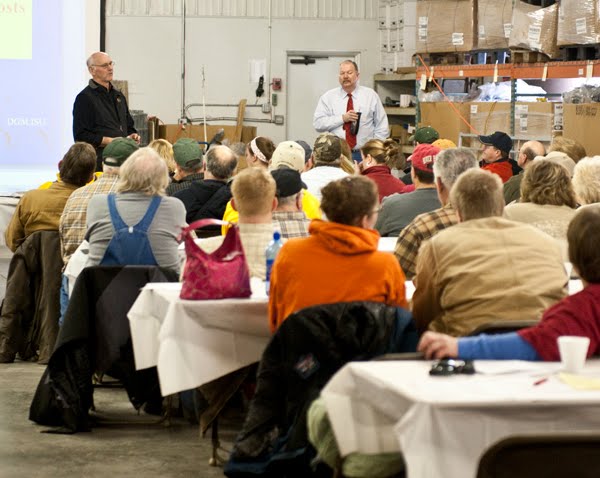
Winter Sheep Day was a success! The 120 attendees were from Iowa, Illinois, Missouri, Indiana, Ohio, Minnesota, Wisconsin, Michigan, South Dakota and California.
Speakers were Dan Morrical from Iowa State University, Byron Leu from ISU Extension Services, Stan and Jean Potratz of Premier and Rob Rule and Greg Ahart from Superior Farms. Greg flew in from California to encourage everyone to raise more sheep.
Stan started the day by discussing the origins of Premier and how it has changed throughout the years. He focused on how management of Premier’s sheep and land has changed. Premier is experimenting with an expanding hair sheep flock while maintaining a wool flock on our home farm.


Photo: Our ewe flock at the East Farm. They are mostly of wool/hair genetics. This year they were bred to dorper/romanov rams.
Greg Ahart and Rob Rule both work for Superior Farms—the largest lamb processor in the United States. They discussed the current lamb market (it's great if you have lambs to sell), how Superior is now adapting to that market and what types of lambs do the best in their markets.
Dan Morrical discussed alternatives to feeding corn. He enlightened us with his experiences with distillers grain's and soybean hulls. He also discussed mineral mixtures and supplements and the need to keep an eye on your animals' nutrition.


Photo: Stan with Greg Ahart (middle) and Rob Rule (right) of Superior Farms.


We paused for lunch, Stan then spoke about Premier’s year one experience with filling their own bellies with baleage (hay silage in bale form) for sheep. He detailed on the process of making baleage, storing and nutrition analysis.
Byron Leu provided an analysis of Southeast Iowa's hay crop for 2010. Iowa State University's Extension Service enabled many hay producers to test their hay and other forages.

Photo: Byron Leu (left) guiding an attendee through the finer aspects of forage analysis.

After the organized discussions, the group split into thirds, one left for the East Farm with Carl McCall to look at our hair sheep and the new barn there.

Others went with Mike Corderman and Dan Morrical to our experimental lambing barn in which the temperature is kept just above freezing. After the walk-through (attendees were required to wear disposable plastic boots for bio-security purposes) of the heated shed, the group went out to our sheep barn where ewes and lambs are kept.


Photo: The inside of our heated lambing shed. Ewes were brought in right before lambing and left within two days after lambing. It's a little cozier than lambing outside.

Mike discussed the layout of the barn with those who were interested and Dan provided everyone with a list of "Lambing Time Tips" and demonstrated said tips on a few of the lambs.

Photo: Mike Corderman (back of the barn) describing the barn and our lambing procedures.

Others remained inside to talk about livestock guardian dogs with Jean Potratz

Overall everyone walked away with an expanded knowledge of the sheep industry, lambing, nutrition and raising sheep in general.


Photos: This year's lamb crop from the home farm. Lambs were sired by an Ile de France buck. Though the blackface lamb in the right photo came from our "experimental" Suffolk buck.

Thursday, January 13, 2011

"Gone With the Fleece"


Photo: Tharren was able to get outside and capture the shearing process, though it appears he used one of the cameras from "The Wizard of Oz".

The sheep have been shorn! Well, at least some of them have. Last week Dave Miller of Riverside, IA came down and sheared 29 sheep in about 2 hours. Mike and Carl collected and weighed the wool, and it turns out the ewes lost over 200 lbs! (The ewes should try out for The Biggest Loser.) I bet you're thinking we're crazy, shearing the ewes of their warm coats in the middle of winter, they'll get cold! There is still enough wool on them to keep them warm.

Photo: "A little off the top." This ewe was kind enough to pose for Tharren while it was being sheared.

The ewes are also pregnant and the removal of their excess wool will enable the lambing process to run a little smoother. The lack of wool will encourage the ewes to go inside to have their lambs. After all, we don't want the lambs first life experience to involve waking up in a snowdrift, that would be awfully traumatizing. The ewes will also be cleaner during and after the birthing process and their lambs will be able to find their first meal much easier without all that wool in the way.

Photo: Mike and Carl thought they could pull the wool over Mr. Miller's eyes by hiding Carl in the wool bag and adding his weight to the total wool collected (not true: they're just compacting the wool so more fits into the bag).

Thursday, January 6, 2011

Winter Sheep Day and other Updates

I thought I would provide an update of the current “happenings” at Premier. Once again catalog season is here, but this season we’re working on the Spring Fence Catalog. Jody and Kerrie are putting together the layout, then Stan and I fill blank spaces with copy. Tharren is busy taking last minute photos (we keep sending the poor guy out into the cold for pictures of insulators). But it's coming together slowly but surely, look for the new catalog in your mailbox the third week of March


Photo: Some lambs that were born a few days after Thanksgiving.

Photo: More Thanksgiving lambs enjoying their time under a roof and out of the snow.
Premier will be hosting a Winter Sheep Day the first weekend of February. Topics covered will be: Addressing High Feeding Costs, High Moisture Bale Feeding (Baleage), Lambing Time Tips for Indoor and Pasture System Operations, Ration Options Using Corn Co-Products, Lamb Marketing Impact of the Sale of Iowa Lamb to Superior Farms. Speakers will be Stan Potratz of Premier, Dan Morrical from Iowa State University, and Byron Leu from Iowa State University Extension. There will also be an opportunity to tour some of Premier's lambing barns.
The event will be held on Feb. 5, from 10:00am to 3:00pm. There is a registration fee of $5 per person or $10 per family. Lunch will be provided by Premier. Please RSVP to Joe jputnam@premier1supplies.com or Cheyenne cmiller@premier1supplies.com. You can also call 1-800-282-6631 to register. Hope to see you there!

Photo: Premier's copywriter showing off his shepherding abilities.